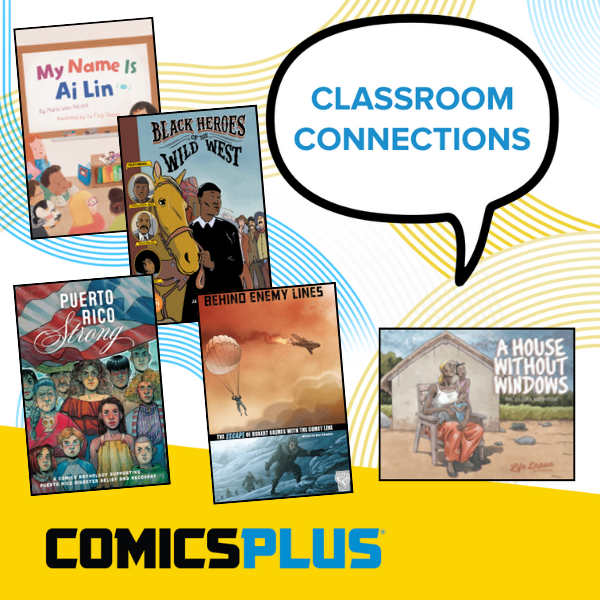
“Classroom Connections” aligns Classroom Standards with comics, graphic novels, manga, and picture books that students will want to read. All titles are available in Comics Plus.
Developing our identity is a process guided by physical and emotional growth, daily learning activities, meaningful experiences, and conscious intentions. We identify similarities and differences; we question relationships; and we examine the factors that influence our decisions and behavior.
Younger learners tend to focus on those closest to them: family, friends, and the people they interact with at school and in their community. As they mature, they discover their own strengths and interests to explore, while engaging with and observing the broader world around them. Eventually, young adults begin the process of distinguishing patterns in human behavior individually and as a group, or within an institution.
Exploring individual development and identity in a classroom setting can be accomplished with a variety of materials available on Comics Plus. Memoirs and personal narratives, nonfiction accounts of historical events, biographies, and even fictional stories offer insights into the development of identity in main characters, historical figures, and the authors themselves.
Memoirs and personal narratives are the real-life experiences of a specific time or period in one’s life, with the author sharing the impact and importance of the experience. Readers learn about the author’s specific abilities, how they interact with other individuals, groups, and cultures as they grow and change physically, cognitively, and emotionally. Nonfiction accounts of historical events provide readers the opportunity to reflect on the actions and deeds of others in different contexts. This kind of reading helps develop critical thinking, empathy, and a deeper understanding of human behavior across time.
Characterization in fictional narratives supports the study of individual development and identity, as authors craft protagonists and antagonists that are relatable to readers. Whether set in historical, mystery, or fantasy stories, characters evolve through the challenges and experiences formulated by the author.
The theme of individual development and identity invites students to explore the world around them by closely observing the people, relationships, and communities in their lives. It encourages them to reflect not only on how others grow and change, but also on the social, cultural, emotional, and personal factors that influence their own evolving sense of self. Through this theme, students begin to understand that identity is not fixed, but shaped over time by experiences, challenges, and interactions with the world.
This month, we’ve selected titles from our Read Your World list that can help broaden students’ awareness of the world — and themselves.
Young Readers
Kevin and the Food Drive by Kristin Johnson and Hannah Wood (Lerner)
NCSS Theme: Individual Development & Identity. Learners will understand people’s interactions with their social and physical surroundings influence individual identity and growth.
Common Core ELA Standard: Retell stories, including key details, and demonstrate understanding of their central message or lesson.
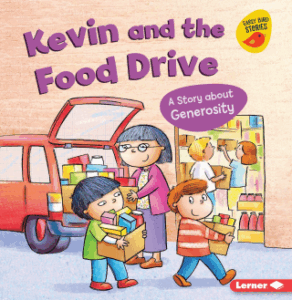 When Kevin discovers that some families in his community are food insecure, he decides to take action. With the help of his friends, Kevin organizes a food drive to collect donations for those in need. Through teamwork and generosity, the group learns that when everyone contributes and shares, there is enough food for everyone to enjoy. Kristin Johnson’s story emphasizes the importance of kindness, empathy, and community involvement, inspiring young readers to recognize their ability to create positive change.
Illustrated by Hannah Wood, the story features vibrant, full-color artwork that is both engaging and age-appropriate for early elementary students. The expressive characters and clear settings help convey the story’s emotions and actions, making it accessible and relatable. The illustrations also support the book’s themes by visually highlighting the spirit of community and generosity.
This title serves as an excellent resource for teachers introducing concepts of community awareness and social responsibility. Kevin’s desire to hold a food drive models leadership, empathy, and collaboration, demonstrating how individual actions can lead to personal growth and stronger relationships. By using this story as a springboard for discussions, role-playing, or classroom projects, such as organizing a food drive, teachers can encourage students to see themselves as active, caring members of their community, whose choices shape their identity and the world around them.
- Comics Plus Collection(s): Elementary, Children’s Public Library, All-Access for Schools, Full Collection
My Name Is Ai Lin by Maria Wen Adcock and Yu Ting Cheng (Cherry Lake)
NCSS Theme: Individual Development & Identity. Learners will understand the study of individual development and identity helps us know who we are and how we change.
Common Core ELA Standard: Describe how characters in a story respond to major events and challenges.
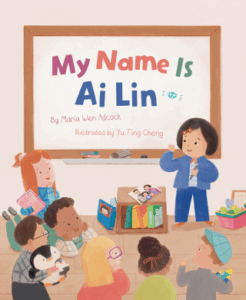 A young Chinese girl shares with her classmates the meaning and significance of her name: Ai means “love” and Lin means “gem”; together they link her to her family, her heritage, and are part of her personal story. She explains that her name was chosen not only for its meaning, but also for its sound, and how it connects her to the world around her.
Yu Ting Cheng uses a soft palette of colors, showcasing vibrant personal environments from the busy classroom to the quiet garden and the comfy family home. The 2-page spreads are filled with all the things little children love: dinosaurs, flowers, bunnies, and soccer balls!
My Name Is Ai Len is a wonderful beginning-of-the-school-year story to introduce the concept of identity with younger students. It encourages them to ask thoughtful questions about themselves, helping them discover who they are. By exploring the meaning and origins of their own names, readers can uncover personal connections to their families, cultures, and the world around them.
- Comics Plus Collection(s): Elementary, Children’s Public Library, All-Access for Schools, Full Collection
That Girl on TV Could Be Me! by Leticia Ordaz and Juan Calle (Immedium)
NCSS Theme: Individual Development & Identity. Learners will understand that individuals bring specific abilities, interests, and talents in working with others to make decisions and solve problems.
Common Core ELA Standard: Ask and answer such questions as who, what, where, when, why, and how to demonstrate understanding of key details in a text.
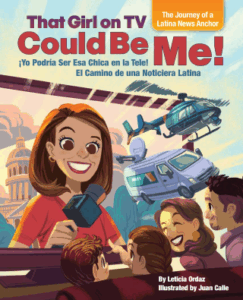 A bilingual (English/Spanish) autobiographical picture book, That Girl on TV Could Be Me! tells the true story of Leticia Ordaz’s journey from a shy little girl in a small California town to becoming a successful television news anchor. Inspired by her hardworking Mexican immigrant parents who valued education, Leticia faced the challenge of not seeing anyone who looked like her on TV. She overcame her fear of public speaking and other barriers to become the first in her family to attend college. Through determination and resilience, she began her career as an intern in local news, learning how to write, produce, and report stories, and eventually fulfilled her dream of becoming a TV news anchor in her hometown.
The artwork by Juan Calle is dynamic and vibrant, vividly capturing the story’s energy and emotion. Characters are expressively drawn, their faces and body language clearly showing their determination, excitement, and pride.
Ordaz’s inspiring story gives teachers a dynamic tool to help young students discover how individual abilities, interests, and talents matter within group efforts. It offers a relatable, real-world example of how diverse roles and collaboration are essential to reaching shared goals, reflected in the daily work of television news production. Teachers can leverage this story to have students reflect on their own unique strengths and how they can contribute to group success, linking personal identity to the classroom community. Students can also explore self-awareness, recognize the value of different talents, and see that understanding both their own and others’ identities strengthens teamwork and problem-solving.
- Comics Plus Collection(s): Elementary, Middle School, Children’s Public Library, Teen Public Library, All-Access for Schools, Full Collection
Middle Grade
Black Heroes of the Wild West: Featuring Stagecoach Mary, Bass Reeves, and Bob Lemmons by James Otis Smith (TOON Books / Astra)
NCSS Theme: Individual Development & Identity. Learners will understand how factors such as physical endowment, interests, capabilities, learning, motivation, personality, perception, and beliefs influence individual development and identity.
Common Core ELA Standard: Explain events, procedures, ideas, or concepts in a historical, scientific, or technical text, including what happened and why, based on specific information in the text.
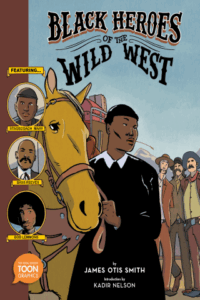 Told through three captivating vignettes, the stories of these Black heroes illustrate their commitment to themselves and their communities. Born into slavery, Mary Fields — aka “Black Mary,” “White Crow,” or “Stagecoach Mary” — is one tough woman finding her way in the “Wild West.” Bass Reeves, the first Black Deputy US Marshal west of the Mississippi River, captured over 3,000 fugitives and learned to speak several Native American languages. And “mustanger” Bob Lemmons developed a deep understanding of wild horses and believed there was a kinder way to bring them to ranchers.
Each story starts with a historical photograph of the subjects, allowing readers to visualize the hero’s persona and character. The artwork highlights the wide-open space of the West while establishing the 1800s time period, and Smith’s use of wordless panels provides an ethereal moment as the reader takes in the actions and their surroundings in the big skies of the “Wild West”.
These heroes’ stories offer readers the opportunity to discuss how their adventures were shaped by different factors that influenced their individual development and identity. Fields’ story highlights her ability to utilize her physical strength to challenge the traditional perception of women. Reeves’ pursuit and capture of the lawless Clancey brothers demonstrates how his intelligence and personality guided his actions. Likewise, Lemmons’ beliefs and interests in wild mustangs encourages readers to consider how they influenced his actions and identity.
Teachers can utilize these stories throughout the school year to encourage students to consider how their own characteristics and traits — interests, capabilities, personality, and beliefs — influence their individual development and identity.
- Comics Plus Collection(s): Elementary, Middle School, Children’s Public Library, Teen Public Library, All-Access for Schools, Full Collection
History’s Kid Heroes: The Horse-Riding Adventure of Sybil Ludington, Revolutionary War Messenger by Marsha Amstel, Ted Hammond; Richard Pimentel Carbajal (Lerner)
NCSS Theme: Individual Development & Identity. Learners will understand that individuals’ choices influence identity and development.
Common Core ELA Standard: Determine a theme of a story, drama, or poem from details in the text, including how characters in a story or drama respond to challenges or how the speaker in a poem reflects upon a topic; summarize the text.
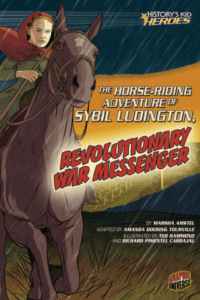 Set in 1777 in the New York Colony, the story begins when a messenger arrives at the Ludington family farm with alarming news of British soldiers burning villages in the area. Colonel Henry Ludington’s militia men are spread across the countryside. His daughter Sybil chooses to volunteer to ride and alert the scattered militia members before it’s too late. She bravely sets out alone on horseback on a cold, stormy night, riding through dark forests. Throughout the night, she faces her fears, outlaws, and the threat of enemy soldiers — but she perseveres.
Hammond and Carbaja’s artwork brings the historical setting and characters to life with vibrant and expressive illustrations, connecting the reader to the characters and making history more appealing.
Amstel examines how individual choices shape personal identity and development. Sybil’s courageous decision to embark on a dangerous nighttime ride highlights key traits such as bravery, responsibility, and initiative. Her actions not only contribute to her own growth but also play a vital role in protecting her family and their community. Her story provides teachers with a powerful example of how personal decisions, particularly in times of crisis, can not only shape a person’s character, but also influence broader historical outcomes.
Readers can learn about many more brave children in the Lerner’s History’s Kid Heroes series.
- Comics Plus Collection(s): Elementary, Middle School, Children’s Public Library, Teen Public Library, All-Access for Schools, Full Collection
Behind Enemy Lines by Matt Chandler and Dante Ginevra (Capstone)
NCSS Theme: Individual Development & Identity. Learners will understand how personal, social, cultural and environmental factors contribute to the development and the growth of personal identity.
Common Core ELA Standard: Compare and contrast the overall structure (e.g., chronology, comparison, cause/effect, problem/solution) of events, ideas, concepts, or information in two or more texts.
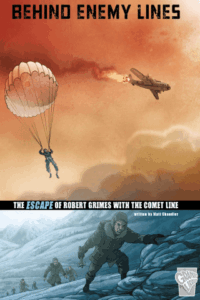 Shot down behind enemy lines, Allied pilot Lt. Robert Grimes finds himself in a desperate race for survival against Nazi soldiers during World War II. His only hope lies with the Comet Line, a daring resistance group dedicated to getting downed airmen out of Nazi-occupied Europe. Grimes’ courage is evident, and so is the courage of the ordinary individuals who risked everything to help him escape.
Chandler’s framing of the story combines action and historical facts to engage young readers and highlight themes of bravery, survival, and cooperation during wartime. Ginera’s artwork is visually engaging and accessible for young readers, with illustrations vividly depicting the historical setting and the characters’ experiences, making the true story more compelling and relatable.
Students can easily explore individual identity in the context of how the environment and social interactions impact our decisions and understanding of the world. Through Grimes’ journey, they will realize how his identity as an American soldier on the run from the enemy shaped his circumstances, decisions, and the people he encounters. His survival depends on forming a relationship with members of the Comet Line and local residents, and these interactions highlight how social networks can shape an individual’s sense of self, trust, and belonging. Grimes navigates through the hostile environment, hiding and moving through unfamiliar territories, which forces him to adapt, develop resilience, and reassess his capabilities. By analyzing these experiences, students can gain insight into how personal, social, cultural, and environmental factors contribute to the development and growth of personal identity.
- Comics Plus Collection(s): Elementary, Middle School, Children’s Public Library, Teen Public Library, All-Access for Schools, Full Collection
Teens & Young Adults
Alice On the Run: One Child’s Journey Through the Rwandan Civil War by Gaspard Talmasse (Humanoids)
NCSS Theme: Individual Development & Identity. Learners will understand the study of individual development and identity helps us know that individuals change, physically, cognitively, and emotionally over time.
Common Core ELA Standard: Analyze the structure an author uses to organize a text, including how the major sections contribute to the whole and to the development of the ideas.
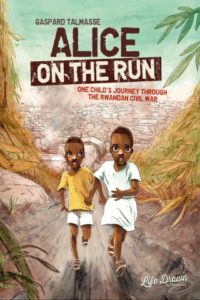 Based on the true story of Alice Cyuzuzo, who was five years old when the Rwandan Civil War and genocide erupted in 1994, Talmasse vividly recounts her ordeal as she and her family are forced to flee their home, embarking on a journey on foot through Rwanda and into Zaire. Told entirely from Alice’s perspective, she and her family suffer relentless hardships; periods in refugee camps, violence, and every gunshot brings the dread that they may have to flee again. Alice describes the exhaustion, hunger, heat, and the torment of not knowing what happens next.
Talmasse’s artwork captures the sense of awe and terror that a child would feel in such dire circumstances. His illustrations often focus on Alice’s facial expressions and body language, showing moments of confusion, hope, and distress, helping the reader understand her experiences, as well as her emotional and psychological state. He avoids sensationalizing violence, instead using the expressive power of visual art to evoke empathy and draw attention to the harsh realities of displacement and survival.
Alice’s story gives students and teachers a meaningful way to explore physical, cognitive, and emotional growth over time. Readers follow her from early childhood into adolescence, showing how her body changes and her needs evolve. As she grows older, Alice begins to understand the world around her more clearly, showing signs of cognitive development. She also learns to cope with loss, separation, and the hardships of survival, which help her grow emotionally. Acts of kindness and moments of perseverance shape her identity as she matures. Creating a timeline of Alice’s personal growth and journey will help students better understand how people grow and change over time. It encourages them to think critically about how life events and challenges influence a person’s development, while also deepening their understanding of historical and cultural experiences.
- Comics Plus Collection(s): Middle School, High School, Teen Public Library, All-Access for Schools, Full Collection
Puerto Rico Strong edited by Marco Lopez, Desiree Rodriguez, Hazel Newlevant, Derek Ruiz, and Neil Schwartz (Oni Press)
NCSS Theme: Individual Development & Identity. Learners will understand that complex and varied interactions among individuals, groups, culture, and nations contribute to the dynamic nature of personal identity.
Common Core ELA Standard: Determine an author’s point of view or purpose in a text in which the rhetoric is particularly effective, analyzing how style and content contribute to the power, persuasiveness or beauty of the text.
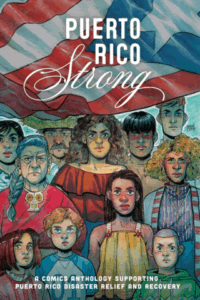 An anthology of short stories sharing the culture, history, events, and experiences that have shaped the people of the island of Puerto Rico. “Blame it on ‘Rico,” by Puerto Rican graphic artist Alberto “Tito” Serrano, who lives in Brazil, is called upon daily to explain his U.S. accent, the color of his skin, and the complicated relationship of being both a U.S. citizen and Puerto Rican. “Cocinar,” by Vito Delsante highlights the central role of food, family, and tradition in the development of his identity. In “Taíno Online,” Joamette Gill delves into her Taíno ancestry to understand the impact and significance of this heritage on her family history. Offering a rich, diverse portrait of Puerto Rican strength, resiliency, and identity, these and many more stories were collected to support the island’s recovery from Hurricane Maria in 2017.
The collection spotlights a diverse range of talented authors and artists, featuring a mix of realistic portrayals of everyday people to fantastical illustrations of mythological Taíno creatures, with each artist capturing the vibrancy, passion, and beauty of the island of Puerto Rico and its people.
Readers will be introduced to Taíno ancestry and the complex history of colonialism in Puerto Rico, sparking a desire to examine, study, and recognize the influences of their own family and friends in the development of our identity. Several of the stories explore the complex interactions and relationships of those who choose to remain on the island and those who move to the mainland. Each narrative expounds on the heartache, longings, and evolving sense of identity felt by each individual navigating both worlds.
Other stories ask readers to consider how ancestral roots influence their family dynamics and cultural traditions. Many stories relate the experiences of islanders who survived the devastation of Hurricane Maria, offering students mentor texts for writing personal narratives about an event or experience that shaped their own individual development and identity.
- Comics Plus Collection(s): Middle School, High School, Teen Public Library, All-Access for Schools, Full Collection
A House Without Windows by Marc Ellison and Didier Kassaï (Humanoids)
NCSS Theme: Individual Development & Identity. Learners will understand factors, both genetic and environmental, that contribute to individual development and identity.
Common Core ELA Standard: Integrate and evaluate multiple sources of information presented in different media or formats (e.g., visually, quantitatively) as well as in words in order to address a question or solve a problem.
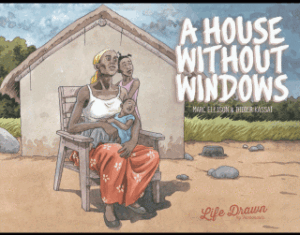 A unique graphic documentary told with a mix of illustrations, photography, and first-person accounts, it tells the story of street children in Bangui, the capital of the Central African Republic, raising awareness of the crisis there, which has often been overlooked. Ellison and Kassaï vividly share the struggles of the young children who have been orphaned, displaced, or forced to survive alone in poverty, violence, and ongoing danger from exploitation, addiction, and abuse. The book’s title serves as a metaphor, expressing how the children have been stripped of shelter, hope, and protection — like houses without windows.
Ellison and Kassaï expertly blend illustrations and photography to immerse the reader in the children’s harsh world, and the realities of life that they face. Kassaï’s art is delicate and subtle, using soft colors that underscore the heavy subject matter without overwhelming the narrative. His illustrations convey emotion and atmosphere while depicting the daily realities of life, and his panels are interwoven with Ellison’s photographs, creating a seamless integration between what’s drawn and real-life documentation.
The unique visual storytelling encourages students to interpret facial expressions, physical settings, and artistic choices to understand how environmental factors, such as family circumstances, loss, conflict, and lack of resources, shape the children’s identity and development. Using the photographs and illustrations as evidence, teachers will be able to facilitate activities where students identify and analyze moments in the story that illustrate how these factors affected the children’s emotional state. Discussions of nature (what children bring with them) vs. nurture (how the environment affects them) will lead students to make cross-cultural comparisons and personal reflections by asking them to consider how their genetic background and environment have influenced their identity, drawing parallels with the children depicted in the book. This discussion will help build empathy and an understanding of identity formation.
- Comics Plus Collection(s): High School, Teen Public Library, All-Access for Schools, Full Collection
Vickie Blankenship and Stella Bromley are Engagement Specialists for LibraryPass, as well as school librarians and educators with extensive experience in librarianship at the elementary, middle, and high school levels. Both bring expertise in professional development and educator training, working with school districts nationwide. They have presented locally, regionally, and nationally on best practices for collection development, library programming, and classroom pedagogy. Active members of their state library associations, they are dedicated to fostering a love of reading in students and educators alike. They share a passion for connecting readers with the “just-right” book and believe that reading takes many forms, whether it’s traditional print books, comics, graphic novels, or manga; as long as readers are engaged with a book, their love for reading will grow.
Read All The Comics!

“An absolute game changer.” School Library Journal
With Comics Plus, schools and libraries can offer readers unlimited access to thousands of digital comics, manga, and picture books from popular publishers like ABDO, Andrews McMeel, Capstone, Cherry Lake, Dark Horse, Europe Comics, Fantagraphics, Humanoids, Image Comics, Kodansha, Lerner, Mad Cave, Manga Classics, Oni Press, Papercutz, Tokyopop, TOON Books, UDON Entertainment, Yen Press, and dozens more.
No holds, wait lists, or monthly borrowing limits—all at a price that won’t break your materials budget.
Learn more at comicsplusapp.com and sign up for a free demo account.
 We curate high-interest, immersive digital content that helps schools and libraries expand and diversify their collections—without breaking their materials budgets.