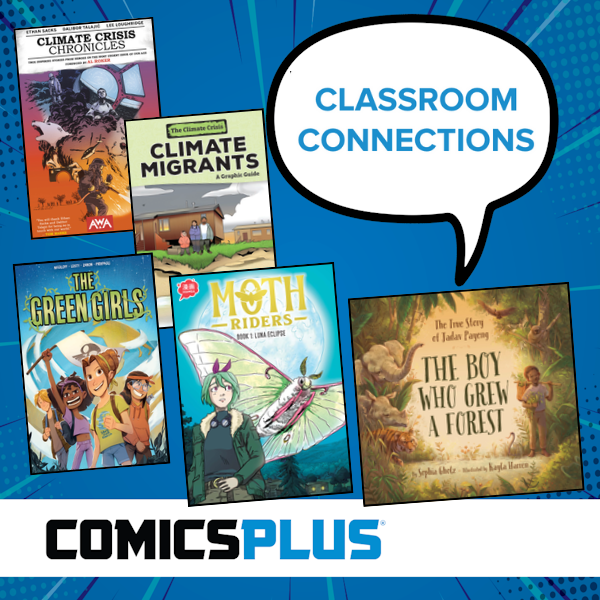
“Classroom Connections” aligns Classroom Standards with comics, graphic novels, manga, and picture books that students will want to read. All titles are available in Comics Plus.
Interconnectedness, relationships, and interactions are central to the NCSS Theme: People, Places, and Environments. Students are encouraged to explore our interconnectedness in the physical world using maps and globes to locate a variety of landforms and population centers. They may study the relationships people have with where they live or why they migrate, or the impacts of seasonal changes on our cultural activities and customs.
These interactions highlight how weather and human activities influence government policies and everyday decisions. This deeper understanding of social, economic, and cultural factors rooted in the human-environmental relationship will empower students to act on behalf of Earth and its people.
On Wednesday, April 22, 2026, we will celebrate Earth Day as a global community. This year’s theme, “Our Power, Our Planet,” reflects a fundamental truth: environmental progress doesn’t depend on any single administration or election. It’s sustained by daily actions of communities, educators, workers, and families protecting where they live and work.”
Our K .12 engagement specialists have chosen titles from our Spring into Reading list to help you celebrate Earth Day, including fiction and nonfiction. You’ll be delivering mail with Mr. Zip to learn about his community; be inspired by one teenager’s ability to revitalize his community; read personal stories related to the climate crisis; and work with Captain Planet and his empowered team to save the Earth!
Each story shows how we can celebrate and deepen our connection to the Earth.
Children
Where’s Mr. Zip? by Annie Auerbach (Dynamite)
NCSS Theme: Learners will understand the theme of people, places, and environments involves the study of location, place, and the interactions of people with their surroundings.
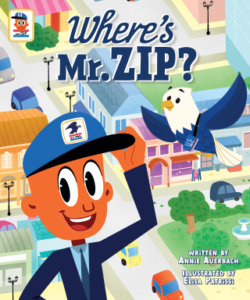 Mr. Zip is a substitute mail carrier. Each day, he delivers mail to different areas of town, with his Bald Eagle companion, B. Franklin, exploring their thriving community. Readers can locate a variety of items specific to each setting. Whether in the city, at the airport, or strolling in the countryside, they deliver the mail with a smile!
Auerbach’s full .color, two .page spreads illustrate microcommunities and events to entice readers to delve deeper into the story, while age-appropriate depictions of animals and a diverse collection of individuals will encourage readers to examine relationships and everyday life.
Activity: With the built-in activity of locating specific items, you can create an additional list of objects related to location and place for students to find in each scene. Consider studying the variety of interactions among people in different settings, and ask students to share details from the text and images to support their understanding. They can also discuss the familial and professional roles individuals play in society.
📚Also consider: Common Core ELA Literature Standard. With prompting and support, ask and answer questions about key details in a text.
- Comics Plus Collection(s): Elementary, Children’s Public Library, All-Access for Schools, Full Collection
The Boy Who Grew a Forest: The True Story of Jadav Payeng by Sophia Gholz and Kayla Harren (Cherry Lake)
NCSS Theme: Learners will understand factors influencing various community, state, and regional patterns of human settlement, such as the availability of land and water, and places for people to live.
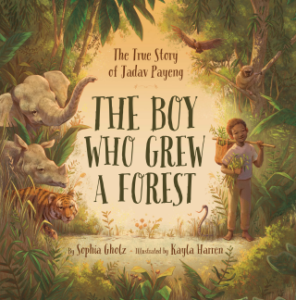 This is the inspiring true story of Jadav Payeng, who began planting trees as a teenager on a barren sandbar in the Brahmaputra River in India. Concerned about the lack of wildlife and greenery, Jadav dedicates himself to changing the landscape one seedling at a time. After decades of patient work, his efforts created a thriving 1,360 acre forest that supports a diverse array of wildlife, including elephants, birds, and many other animals.
Harren’s realistic artwork transports readers to the island setting — depicting both the barren, eroded shorelines at the story’s beginning, and the thriving, forest ecosystem that develops over time. Her details complement Jadav’s encouraging environmental message.
Activity: Have students create a map depicting Jadav’s island at three stages: during the crisis (eroded sandbars, no vegetation, stranded animals); midway through revitalization; and as it is seen today (1,300 acres of forest with returning wildlife). Students can label key factors on each map: water access (Brahmaputra River); available land for natural resources (trees for shelter); and wildlife. This visual comparison will deepen their understanding of the connections between historical and current environmental policies that directly threaten the community. As they work on their map, continue to reinforce the themes of environmental stewardship, perseverance, and the power of individual action to create meaningful change: you’re never too young to make a difference for the planet.
📚Also consider: Common Core ELA Informational Text Standard. Describe the connections between a series of historical events, scientific ideas or concepts, or steps in technical procedures in a text.
- Comics Plus Collection(s): Elementary, Children’s Public Library, All-Access for Schools, Full Collection
Kids
Moth Riders Books 1 & 2 by Jason Burns and Gcomics (ABDO)
NCSS Theme: Learners will understand the concept of regions that identify links between people in different locations according to specific criteria (e.g., physical, economic, social, cultural, or religious).
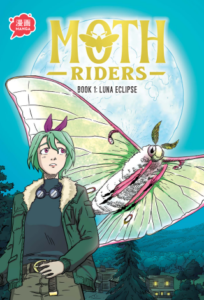 The Luna Moth arrives each night, eclipsing the moon while circling the village. It is believed that she is drawn to the moon’s light, but in reality, she is there to help Aster and her friends save the planet. The village’s tyrant and his army of “The Six Leg Slayers” are destroying the larger-than-human insects and the environment. With her friends and connections to other communities, Aster creates a plan to resist and protect the land, the insects, and ultimately, humans.
Gcomics’ detailed black-and-white landscapes and insects bring into context the large, intimidating appearance of the insects in this world, while the use of onomatopoeia adds action and sensory effects to the reading. The variety of perspectives provides the reader with depth into the emotions and urgency of their actions.
Activity: The landscape and setting of the Moth Riders series are important to document due to their influence on the characters and the rising action of the story. Ask students to create a map of the group’s journey, identifying geographical landmarks and noting how they influence the characters in the story, both human or insect. Discuss their alliances and interdependence, along with the cultural differences between villages and species. To conclude the reading, ask students to choose one of the geophysical themes or central ideas, and share only the specific details from the text that correspond to it.
📚Also consider: Common Core ELA Literature Standard. Determine a theme or central idea of a text and how it is conveyed through particular details; provide a summary of the text distinct from personal opinions or judgments.
- Comics Plus Collection(s): Elementary, Middle School, Children’s Public Library, Teen Public Library, All-Access for Schools, Full Collection
Climate Migrants: A Graphic Guide by Christina Hill and Ash Stryker (Lerner)
NCSS Theme: Learners will understand past and present changes in physical systems, such as seasons, climate, weather, and the water cycle, in national and global contexts.
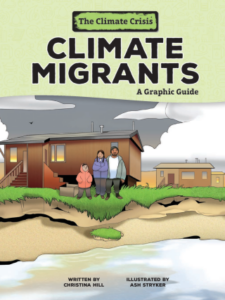 This introduction to climate migration covers essential topics, including climate change, climate justice, climate refugees, extreme weather events, and food insecurity. Hill’s focus highlights current concerns, with firsthand accounts from those affected by climate migration — the Gobi Desert droughts, Mozambique cyclones, and Alaskan coastal erosion and sea level rise — helping create an emotional connection to the challenges they face. It provides a powerful call to action, inspiring readers to champion equitable climate action and uphold the belief that all people deserve a place to live.
Stryker’s artwork features precise linework and a thoughtful color palette, using a combination of warm and cool colors to distinguish between different settings and moods. The panel layout varies and guides readers through both informational content and personal narratives, portraying the stark reality of our changing landscapes.
Activity: Have students discuss interactions between humans and environmental events, examining how they influence each other. Ask students to identify specific physical systems and pinpoint the exact locations that have driven climate migration worldwide. Use color-coded symbols to indicate the physical system responsible for each migration. For example, students can label water cycle disruption (blue), extreme weather (orange), climate/temperature change (red), and seasonal pattern shifts (green). This hands-on activity provides students with an opportunity to examine how physical systems (seasons, climate, weather, water cycle) continue to change, and how that scientific understanding connects to real-world human consequences at national and global levels.
Explore more of Lerner’s The Climate Crisis series and delve deeper into Animal Extinction, Climate Activist, Forests and Deforestation, and more!
📚Also consider: Common Core ELA Informational Text Standard. Analyze the interactions between individuals, events, and ideas in a text (e.g., how ideas influence individuals or events, or how individuals influence ideas or events).
- Comics Plus Collection(s): Elementary, Middle School, Children’s Public Library, Teen Public Library, All-Access for Schools, Full Collection
Teen
Captain Planet #1 by David Pepose and Emmanuel Casallos (Dynamite)
NCSS Theme: Learners will understand past and present changes in physical systems, such as seasons, climate, weather, and the water cycle, in national and global contexts.
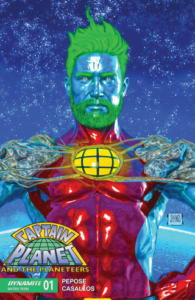 Gaia, the high priestess of Earth, is under attack. With the power of her five rings, she calls upon Captain Planet to rescue her. With the Captain unable to withstand Lucian Plunder and his corporate goons, Gaia sends the powerful rings to find five honorable hosts. Will they be able to understand and use the powers of earth, fire, wind, water, and heart to save the planet?
Brilliant color, dynamic action, and quality pacing fill Casallos’ panels and pages with each ring’s color and the power it represents, while each host’s background and persona are enhanced with the shades and tones of their power.
Activity: Discuss the concept of geographic or place-based climate, seasons, and weather by utilizing the individual host stories to analyze regions and current environmental threats. Create a Venn diagram that compares and contrasts fictional accounts, with past and present examples. The study of geographic locations provides background information for analyzing the importance of these settings to the development of the individual characters and how this information drives the plot.
📚Also consider: Common Core ELA Literature Standard. Analyze how particular elements of a story or drama interact (e.g., how setting shapes the characters or plot).
- Comics Plus Collection(s): Middle School, High School, Teen Public Library, All-Access for Schools, Full Collection
The Green Girls by Loïc Nicoloff, Alberto Zanon, and Roberta Pierpaoli (Lerner)
NCSS Theme: Learners will understand the concepts such as: location; physical and human characteristics of national and global regions in the past and present; and the interactions of humans with the environment.
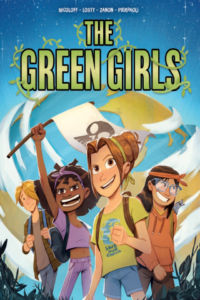 This graphic novel follows Emma, Lily, and Fadila — three frustrated teens who want to protect and save the planet, but feel like no one around them cares. After their school’s organic vegetable garden fails to generate interest, they name themselves the Green Girls and turn to social media to make their voices heard. With their classmate Silas, the girls stage a series of bold, high-profile protests to raise awareness of environmental issues and ask their followers to take action.
The story takes place in Grenoble, France, and features action-packed scenes, such as dramatic protests, and intimate moments of friendship and understanding of conflict and consequences. Zanon and Pierpaoli’s illustrations are bright, colorful, and eye-catching, bringing energy and visual appeal to the story. The art effectively balances action-packed moments with more intimate, character-driven scenes that depict family dynamics and friendships.
Activity: Have students participate in a past vs. present environmental impact analysis. For this activity, have them select and research one environmental issue from the book, focusing on how human-environment interactions have changed over time in a specific region. For example, they could investigate pollution from container ships in major port cities, comparing historical shipping practices with modern methods. Or, they could examine how palm oil production has transformed regions of Southeast Asia over time. Invite students to create a visual timeline that illustrates how both the physical landscapes and the human characteristics of these regions have evolved, analyzing the physical and human regional characteristics and the complex interactions between them, while engaging with the story’s compelling narrative and themes of activism.
📚Also consider: Common Core ELA Literature Standard. Determine a theme or central idea of a text and analyze in detail its development over the course of the text, including how it emerges and is shaped and refined by specific details; provide an objective summary of the text.
- Comics Plus Collection(s): Middle School, High School, Teen Public Library, All-Access for Schools, Full Collection
Young Adult
Climate Crisis Chronicles by Ethan Sacks and Dalibor Talajić (AWA)
NCSS Theme: Learners will understand consequences of changes in regional and global physical systems, such as seasons, climate, weather, and the water cycle.
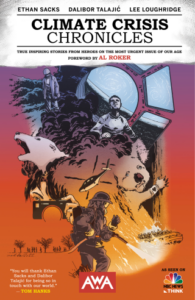 Journalist Sacks and artist Talajić achieve something remarkable: they cut through the overwhelming data and statistics of climate change to present the global crisis in a deeply personal light, with ten illustrated stories that put faces, names, and lived experiences on the front lines of our planet’s most urgent challenges. These true stories feature different perspectives, a variety of physical systems, and the subject’s personal thoughts.
Stories include a firefighter battling seasonal wildfires in California; a human rights activist navigating the aftermath of two successive hurricanes in Honduras; and a photojournalist documenting pollution in Asia. This collection is particularly valuable for cross-curricular classroom use, as it connects science, social studies, geography, and current events. These stories inform, but more importantly, they inspire action and empathy equally.
Talajić’s illustrations are powerfully balanced between documentary realism and emotional storytelling. Panel layout varies from full-page spreads to tighter, multi-panel sequences, with the color palette establishing mood and atmosphere. His use of a realistic, journalistic style in the illustrations reinforces the factual narrative, and makes the complex subject matter more accessible to readers.
Activity: Students can deepen their understanding by selecting a story from the chronicles to create visual cause-and-effect chains that trace the progression of a changing climate crisis and its impacts. Ask them to identify the region of initial impact and the physical system, such as rising temperatures, consecutive hurricanes, or shifting weather patterns. Research and document how these changes manifested in observable ways in the story, and explore the historical and current perspectives. They can analyze the direct consequences, and how these environmental changes can lead to social, economical and political shifts, and understand that climate change does not occur in isolation, but is part of interconnected global systems, in which changes in one physical system can cause other effects across multiple regions and populations. By tracing these connections visually, students gain a better understanding of how seasonal, climate, and weather changes impact both local communities and the broader world.
📚Also consider: Common Core ELA Informational Text Standard. Analyze a complex set of ideas or sequence of events and explain how specific individuals, ideas, or events interact and develop over the course of the text.
- Comics Plus Collection(s): High School, Teen Public Library, All-Access for Schools, Full Collection
Vickie Blankenship and Stella Bromley are Engagement Specialists for LibraryPass, as well as school librarians and educators with extensive experience in librarianship at the elementary, middle, and high school levels. Both bring expertise in professional development and educator training, working with school districts nationwide. They have presented locally, regionally, and nationally on best practices for collection development, library programming, and classroom pedagogy. Active members of their state library associations, they are dedicated to fostering a love of reading in students and educators alike. They share a passion for connecting readers with the “just-right” book and believe that reading takes many forms, whether it’s traditional print books, comics, graphic novels, or manga; as long as readers are engaged with a book, their love for reading will grow.
Read All The Comics!

“An absolute game changer.” School Library Journal
With Comics Plus, schools and libraries can offer readers unlimited access to thousands of digital comics, manga, and picture books from popular publishers like ABDO, Andrews McMeel, Capstone, Cherry Lake, Dark Horse, Europe Comics, Fantagraphics, IDW, Image Comics, Kodansha, Lerner, Mad Cave, Manga Classics, Oni Press, Papercutz, Tokyopop, TOON Books, UDON Entertainment, Yen Press, and dozens more.
No holds, wait lists, or monthly borrowing limits—all at a price that won’t break your materials budget.
Learn more at comicsplusapp.com and sign up for a free demo account.
 We curate high-interest, immersive digital content that helps schools and libraries expand and diversify their collections—without breaking their materials budgets.