Dr. Raylene Gomez Hernandez — former Professor/Instructor of Literary Studies/Creative Writing focused on Comic Books in the Gateway Program at IWU, and former second language acquisition (French and Spanish) Professor/Teacher at Illinois State University, Heartland Community College and District 116 Urbana High School — presented on “Comic Books In Class” during our “Comics in Higher Education: From Collections to Scholarship” webinar. We’re spotlighting our key takeaways here for those who prefer reading over video or audio, but the full webinar is also embedded below.
 Comics and manga have gained popularity in classrooms at every level. In higher education, they are also supporting academic course objectives and research initiatives, while enabling libraries to diversify their collections.
Dr. Raylene Gomez Hernandez — Sociolinguist and Cultural Anthropologist; Anime and Manga Researcher — developed a course structure you can replicate when using comics and manga as course materials, and/or as the subject of your course at the collegiate level.
“Usually I structure my overview for my classes in four stages. I think it really helps the students to see four different levels of development in any course that I teach,” Dr. Gomez Hernandez explains. Her structure includes presenting the focus of the course, the methodology of analysis, the advantages of using the medium, and the objectives for the course.
In order for this course structure to be successful, Dr. Gomez Hernandez emphasizes the importance of determining what you want students to learn and do by the end of the semester first. While she dives deeper into each of the four different levels of development for comic books in college courses during the webinar, the steps outlined below bring the top-level process to the forefront for quicker application in your own course planning.
Stage 1: Focus of the Academic Course
For the focus of the course, Dr. Gomez Hernandez presents the history behind building blocks that led to the present day’s rich comic book culture, and to have them look at each comic book as a product with the ability to deconstruct and understand all of its components. She believes it’s very useful for students to see every single part of the comics used in the course, to understand the labels, names, and language of the medium so that they can truly analyze it further.
“When it comes to the focus, I love comics so much in general, that’s my passion, but I do understand that a lot of my students come in — first-year college experience — and they might not be in love with it. They might take my class because it has some kind of requirement for them or the title sounds like fun,” Dr. Gomez Hernandez states.
From the deconstructing the product, she has students consider context and impact by pushing them to investigate and inquire.
“What are the aspects that surround the creation of this comic book? What kind of impact did it have on the social atmosphere of the time? What was the target audience? What are we representing in the story of the comic that’s just been shown to us? There is a lot of different fun aspects that I believe are essential for them to understand,” Dr. Gomez Hernandez explains.
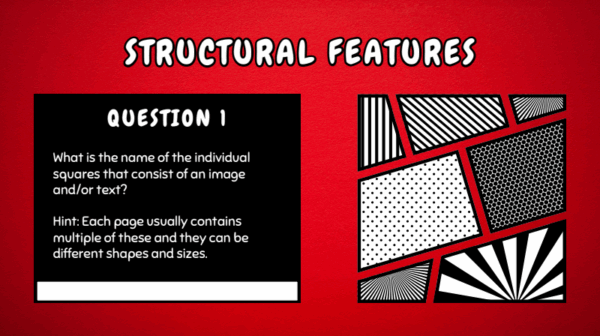
Structural Features research question Dr. Gomez Hernandez asks her students during the focus on analysis of structure & composition, and context & history in her college-level comics courses.
Finally, at the end of this stage, she draws her students’ attention to information and media literacy. This creates better understanding when they find new comics and form their own opinions.
“If we understand how to read these products, how to see them, and also all the information they carry, then we can better understand when find a new one, and we can have our specific opinions in an educated way of new products coming up and the representation in the media,” Dr. Gomez Hernandez shares.
Through analysis of structure and composition, as well as context and history, she ensures her students understand all of the structural aspects to have the language required to talk about comics on a higher level. By having a digital collection like Comic Plus, students in her courses have a powerful too to search for comics and manga they can use during the course.
“There is so much to go into. My university has [Comics Plus] and it’s very, very well curated. We’re going to work with [what you find] for the rest of the semester,” she details.
Stage 2: Methodology of Comics Analysis
By using their chosen comic or manga for the entire semester, this means that students’ questions become more nuanced and critical thinking is applied.
- What is the difference between manga and comic books in terms of orientation reading?
- How are gender, race, ethnicity, social class, education level, religious affiliation, and able-bodiedness represented in the story?
“We look at the history of the comic book. We look at the origins of Marvel, we also look at the origins of the first female superhero. For Manga, we look as far back as Astro Boy and then [we] jump to Dragon Ball as the father of the big three: Bleach, Naruto, [and] One Piece. I always push my students to go analyze it, get the research, because that’s why you will better understand what we’re talking about. Who is the target audience and during what set of social, political, and cultural circumstances was this work printed?” Dr. Gomez Hernandez expands.
At this stage, Dr. Gomez Hernandez challenges her students to question whether the comics they’ve individually selected for their coursework in her class are good or bad — through the lens of literary features. This encourages students to determine if they can sustain their opinion beyond whatever initially appealed to them.
“Is it good because you like it, or is it good because you can sustain with a different reasoning why it’s good. We go more into the story construction, the narrative, the dialogue. Are we talking about a unit story or a multi-piece story? How would you argue and sustain the reasoning being the commercial success or lack of from this product?” she details.
The underlying message and development of an informed opinion is meant to drive students to think critically and these contextual features are important for developing a strong argument in the papers they must write in Dr. Gomez Hernandez’s courses. Challenging students to think critically is her main driver as a professor.
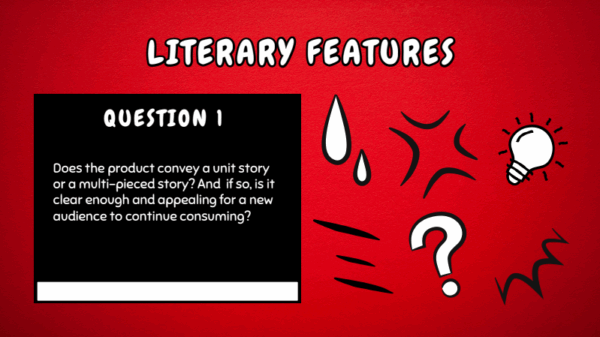
Literary Features research question Dr. Gomez Hernandez asks her students during the Methodology of Analysis stage in her college-level comics courses.
Stage 3: Advantages of Using the Comics Medium
Students in Dr. Gomez Hernandez’s courses are asked to write four papers during the semester, each adaptable for level of difficulty. These four papers allow students to apply what their critiquing, processing, discussing, and discovering through inquiry during the course — making comics and manga a great medium to use in college coursework, where encouraging them to use their brains is the primary objective.
“For majors that are talking about literary studies, the first paper I ask [students] to basically [deconstruct] a comic book, tell me about the structure and composition of it. Paper number two, is body of context. Paper three, body of opinion/consideration. [And], final project is putting all of the papers together in a newer version and now we add something that I call ‘the body of appeal,’’ Dr. Gomez Hernandez explains.
For Body of Context, you want your students to explore the history behind the comic — its background and themes, how was it commercially received — demonstrating they have done a deeper read using the tools you’ve given them to do so.
For Body of Opinion/Consideration, students are expected to decide is the text good or bad, why they think so, and why they use that language to call into question the quality of something. This paper is the midterm in her course and prepares students to support their claims in their final project.
That Final Project, Body of Appeal, asks students to present their chosen comic as an analysis for an audience that has never read about the comic or its topic before. The challenge is to decide how best to appeal to this new audience — for either reading the comic, or warning them away from it.
“That creates an academic voice for the students that they can depend on,” Dr. Gomez Hernandez proudly states.
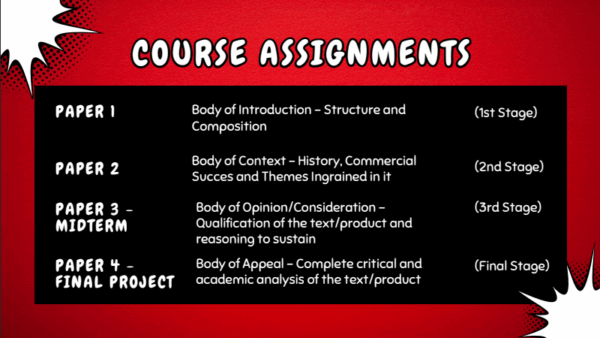
Course assignment details for the papers students in Dr. Gomez Hernandez’s college-level comics courses are required to write.
Stage 4: Objectives of the Academic Course
Because Dr. Gomez Hernandez sees and uses comics as an educational medium, her students get three key takeaways from her courses — visual and information literacy, historical knowledge, and cultural knowledge.
Visual and information literacy each give her students the ability to understand panels and art, and analyze a cover beyond its aesthetic appeal. With that comes a better understanding of narrative, context, and character representation. Historical knowledge provides students’ with an understanding of the origin and reasoning behind the commercial success of traditional, modern, and current comics, while cultural knowledge ensures they know the impact on other media and pop culture.
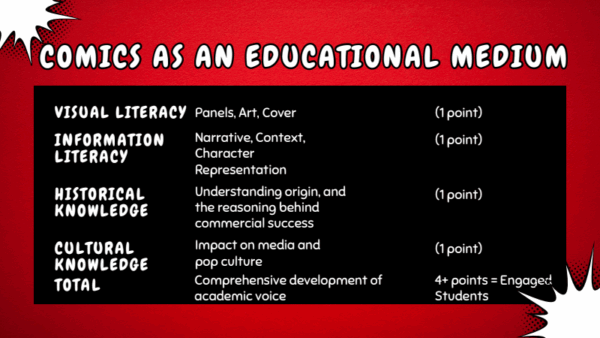
Detailed explanation on the objective ways in which comics work as an educational medium in Dr. Gomez Hernandez’s comics college-level courses.
“As a cultural studies academic, I always like to pass on to my students how do we understand media and pop culture, and how do comics play into that — to build our own perception of our society. Being a product that’s sold so widely across the country, and the world, comic books hold a lot of power,” Dr. Gomez Hernandez shares.
Program All The Comics!
Comics and manga have gained popularity in classrooms at every level. In higher education, they are supporting academic course objectives and research initiatives, while also enabling libraries to diversify their collections.
With Comics Plus, librarians can launch courses in partnership with faculty at their colleges and universities, just as Pamela did at SDSU — without having to worry about holds, wait lists, or borrowing limits. Thousands of comics and manga are available for readers of all ages and interests — with unlimited, simultaneous access for all.
**Learn more about Comics Plus and our valuable resources, including the Comic & Manga Book Club Guide.**
Comics in Higher Education: From Collections to Scholarship | Archive & Resources
In this free webinar, you’ll get an insightful overview of where comics and manga fit in academic libraries and college coursework from Dr. Raylene Gomez Hernandez, Illinois Wesleyan University, and Pamela Jackson, San Diego State University Library. Topics include working with faculty to develop a comprehensive curriculum, and how comics can be used for academic inquiry and writing skills development.
View the full archived recording here, and then check out additional resources and download a certificate of completion.
Read All The Comics!

“An absolute game changer.” School Library Journal
With Comics Plus, schools and libraries can offer readers unlimited access to thousands of digital comics, manga, and picture books from popular publishers like ABDO, Andrews McMeel, Capstone, Cherry Lake, Dark Horse, Europe Comics, Fantagraphics, IDW, Image Comics, Kodansha, Lerner, Mad Cave, Manga Classics, Oni Press, Papercutz, Tokyopop, TOON Books, UDON Entertainment, Yen Press, and dozens more.
No holds, wait lists, or monthly borrowing limits—all at a price that won’t break your materials budget.
Learn more at comicsplusapp.com and sign up for a free demo account.
 We curate high-interest, immersive digital content that helps schools and libraries expand and diversify their collections—without breaking their materials budgets.