
Pamela Jackson, Comics Arts Librarian and Co-Director of Center for Comics Studies at San Diego State University, presented on “From Collections to Curriculum: Comics at SDSU” for our “Comics in Higher Education: From Collections to Scholarship” webinar. We’re spotlighting our key takeaways here for those who prefer reading over video or audio, but the full webinar is also embedded below.
 Developing a comics collection is hard work for even the most engaged comics librarians. In academic settings, there are an array of interests and disciplines to accommodate that require an ongoing collection development process.
Pamela Jackson, Comics Arts Librarian, knows this conundrum very well. At San Diego State University (SDSU), where she is a librarian and Co-Director of Center for Comics Studies, there existed a small collection of comics prior to 2021 — but it mostly included underground and indie titles.
“We did have a few classes using comics but it was really the collection that jump started our curricular efforts on campus. If you’re a librarian you know that that’s a big deal. [It’s] pretty cool to have your collection be what starts a whole movement of curriculum on campus,” Pamela shares.
How can you bring a comics collection to your academic library and align it to curriculum development and planning of your academic programs? Pamela’s method includes three replicable steps. We’ve spotlighted each step she used to develop SDSU’s comics collection, bring comics-focused classes to students, and support a comics curriculum.
Step 1: Build Your Collection
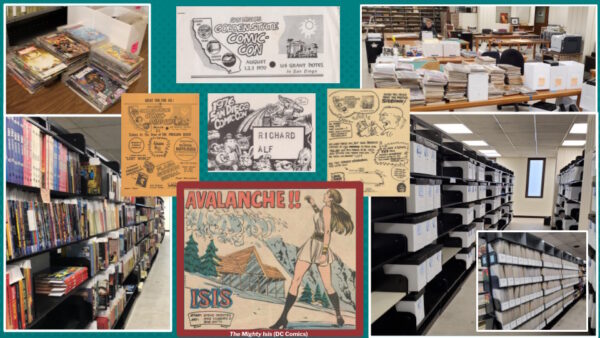
SDSU’s initial comics collection included 1,800 single-issue comic books, as well as graphic novels and collected editions. To develop the collection further, Pamela focused on amplifying marginalized voices and material that supported diversity, equity, and inclusion — since much of SDSU’s curriculum examines social issues.
“I always pay special attention to collecting comics that celebrate and complicate diversity representation and that document the human condition, and shed light on social issues in terms of where our comics live in the library,” Pamela explains.
With more than 120,000 published comics in all formats (as of Spring 2024), including digital formats, SDSU’s collection has shaped up to be quite impressive.
Building and funding the collection wasn’t easy, though. Pamela applied for two grants that helped establish the collection SDSU has today. Those grants were large funding opportunities: the SDSU President’s Big Idea Grant of $50,000 and the National Endowment for the Humanities $150,000 grant for Pamela’s proposal Building a Comics and Social Justice Curriculum at SDSU.
“[We have] been able to create a formally recognized Center for Comic Studies and to build out a comics curriculum where we added 10 brand new comics-specific focused courses in addition to the classes that we already had on the books,” Pamela shares.
Of course, not every university and academic library will be able to receive such grants, or of similar amounts, when developing their own comics and manga collection. This is where digital collections can be a factor. SDSU pays for access to databases of digital comics, while the San Diego Public Library’s Comics Plus collection is also available to their students and faculty.
“One of the difficulties of managing collections in libraries like this is that budgets are often rather limited for anything that is a non-degree granting program. There’s not a major or a minor in comics studies on my campus, so I really [had] to lobby and justify the financial support sometimes to include the materials, and that’s easier to do when you have a rich curriculum,” Pamela details.
Step 2: Co-Create Comics-Focused Courses
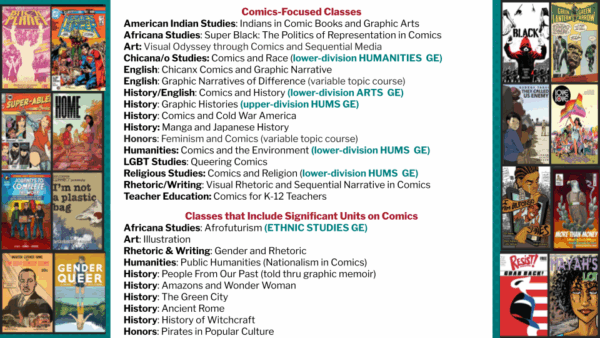
With the funding Patricia received, she was able to work with faculty at SDSU to build out 10 brand new comics-specific courses. By Fall 2024, students were able to earn a formal certificate in comics studies on their transcripts because it is interdisciplinary and no one department owns comics at SDSU. The 12 college credit courses range across departments from American Indian Studies, History, and English to LGBT Studies, Art, and Teacher Education.
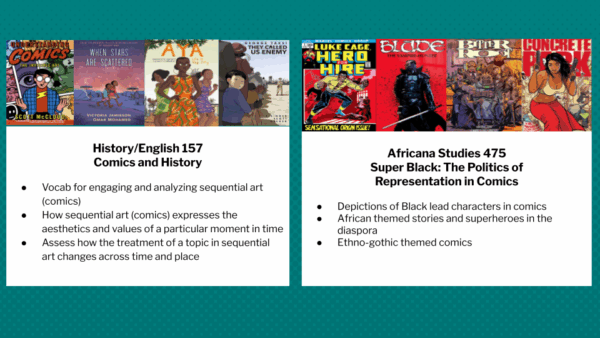
- For HIST 157 Comics and History, the curriculum was developed around vocabulary used to engage and analyze sequential art in comics, how sequential art expresses the aesthetics and values of a particular moment in time, and how to assess the treatment of a topic in sequential art through changes across time and place.
- For RWS 413 The Rhetoric of Comics, the curriculum was developed around the elements of visual rhetoric and sequential narrative (i.e. movement, frame, image, word, and flow) and how to analyze comic texts with sensitivity to their inclusion and representation of diverse cultural characters and stories.
With courses like Religion and Comics, Comics for K-12 Teachers, Visual Odyssey through Comics and Sequential Media, Queering Comics, Comics and Race, and more, Pamela and the faculty at SDSU were able to bring genuine inquiry and application with the use of comics and manga as the source material.
“I frame what I do as a professional using [values such as] challenge power and privilege, recognize economic inequality, bolster democracy, and work for the common good. Critical Librarianship, this is what I try to bring to my everyday work,” Pamela explains.
Step 3: Support Ongoing Comics Curriculum
Most importantly, when bringing comics to academia, whether as a librarian or faculty staff, you must frame your efforts towards this work as being critical, too. Advocating for social justice and human rights by learning about the relevant materials available in comics and manga form will ensure you have a hand in developing engaged, informed, and empowered students who go off to be active participants in their communities.
But you can’t simply make the material available; you have to ensure students will learn from them and be able to apply those learnings. Pamela helped develop coursework assignments for this reason.
Discussion boards; term papers and essays; multimodal assignments of essay, comic, short film, podcast, or other; creating a unit plan for a single grade of K-12 students — these are only some of the types of assignments applied in the classes at SDSU.
“You can see the range from standard term paper and the like to things that are tech heavy, digital humanities-based projects; things like creating a digital timeline of how comics have changed over time, for example,” Pamela highlights. While not every student who takes a comics course is going to be a super nerdy fan, they might think the class sounds really cool and that’s something to be encouraged; librarians can be ready to help faculty and students use this process and approach to learning.
Pamela has spent a considerable amount of time helping students identify characters, series, and specific issues on their chosen topic. She’s also experienced the reverse with teaching faculty. They might not be super fans of comics and manga, but they do want to teach the material or include the medium in their overall course topic.
“I usually do readers lists for them, so that they can help figure out what to use in the classes. It’s a balancing act between showing students how to do this aspect of the research themselves or having the student focus fully on the learning outcomes for a given course,” Pamela states.
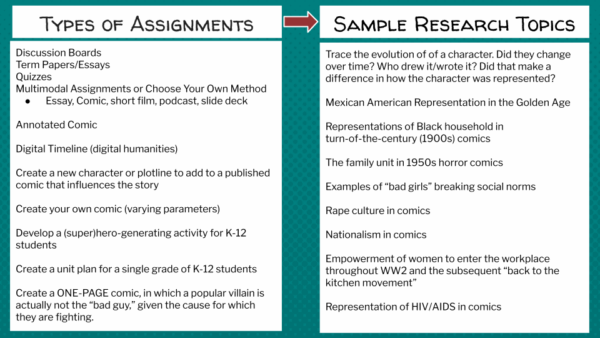
To help with the former, you can do as Pamela has: create cheat sheets. This provides students with a list of comics that work for the topics they’ll cover in class. If you have a class on Nationalism and Comics, or ancient Rome, you can focus comics and manga that tell stories relevant to those topics.
You want to make the experience symbiotic where students can balance how much time they put forth researching comics that match the topics they’re studying versus fully digesting the context of those materials. “We don’t want the students to spend an exceptional amount of time trying to figure out which comics do that,” Pamela shares.
Program All The Comics!
Comics and manga have gained popularity in classrooms at every level. In higher education, they are supporting academic course objectives and research initiatives, while also enabling libraries to diversify their collections.
With Comics Plus, librarians can launch courses in partnership with faculty at their colleges and universities, just as Pamela did at SDSU — without having to worry about holds, wait lists, or borrowing limits. Thousands of comics and manga are available for readers of all ages and interests — with unlimited, simultaneous access for all.
**Learn more about Comics Plus and our valuable resources, including the Comic & Manga Book Club Guide.**
Comics in Higher Education: From Collections to Scholarship | Archive & Resources
In this free webinar, you’ll get an insightful overview of where comics and manga fit in academic libraries and college coursework from Dr. Raylene Gomez Hernandez, Illinois Wesleyan University, and Pamela Jackson, San Diego State University Library. Topics include working with faculty to develop a comprehensive curriculum, and how comics can be used for academic inquiry and writing skills development.
View the full archived recording here, and then check out additional resources and download a certificate of completion.
Read All The Comics!

“An absolute game changer.” School Library Journal
With Comics Plus, schools and libraries can offer readers unlimited access to thousands of digital comics, manga, and picture books from popular publishers like ABDO, Andrews McMeel, Capstone, Cherry Lake, Dark Horse, Europe Comics, Fantagraphics, IDW, Image Comics, Kodansha, Lerner, Mad Cave, Manga Classics, Oni Press, Papercutz, Tokyopop, TOON Books, UDON Entertainment, Yen Press, and dozens more.
No holds, wait lists, or monthly borrowing limits—all at a price that won’t break your materials budget.
Learn more at comicsplusapp.com and sign up for a free demo account.
 We curate high-interest, immersive digital content that helps schools and libraries expand and diversify their collections—without breaking their materials budgets.