

“Classroom Connections” aligns Classroom Standards with comics, graphic novels, manga, and picture books that students will want to read. All titles are available in Comics Plus.
Studying the past is more than memorizing dates, names, and places. It’s exploring individual legacies; examining institutions that helped shape societies; and investigating the values and beliefs that guided and influenced the events, people, and policies that affect the present.
This deconstruction of history helps students step into different worlds and understand how our past — on a local, national, and global level — has shaped us and the world we live in. Socially, politically, and culturally, it encourages us to think critically about continuity and change. We are all affected by the decisions and outcomes of events that occurred before and during our lifetime, and to understand the present, we need to understand the past.
The theme of Time, Continuity, and Change prompts students to ask questions, interpret historical information, and gain a deeper understanding of history. Learning about our community, our nation, and the world can be challenging. The comics medium provides a more approachable way to explore past mistakes and troubled times through the combination of images and text.
Our curated list, History for Everyone, showcases a range of titles that explore the facts about important people and events of the past, and celebrates the human experience throughout history. We’ve selected a handful of titles that can easily be integrated into classroom activities with relevant standards to align them with your curriculum.
Young Readers
So Much More to Helen: The Passions and Pursuits of Helen Keller by Meeg Pincus and Caroline Bonne-Müller (Cherry Lake)
NCSS Theme: Time, Continuity, and Change. The learner will understand key people, events, and places associated with the history of the community, nation, and world.
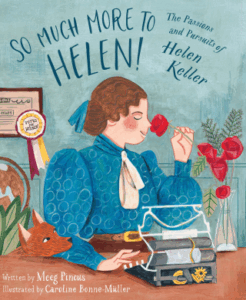 The story of Helen Keller can be told from multiple perspectives, revealing a variety of facts about her life and her profound impact on the world. This picture book does just that in a way that allows the reader to learn about her through rhyming couplets or to delve deeper into the informational text at the bottom of the page. Helen Keller was much more than a deaf and blind child who learned to communicate through the teachings of Anne Sullivan; readers will learn how her beliefs and values have shaped the modern world.
Caroline Bonne-Müller’s colorful, detailed images support readers by sharing intimate relationships, historical perspectives, and the elements of her everyday life. Each page places Keller center stage, illustrating changes in fashion, transportation, and society as a whole.
Meeg Pincus highlights how Keller’s legacy has influenced the lives of people with disabilities and the women’s rights movement. Readers will discover the changes that took place within her lifetime and pinpoint how continuity, such as the importance of education, remains relevant today, just as it was in the early 1900s.
Educators can also pair this title with other graphic biographies, Helen Keller: Courageous Learner and Leader (ABDO) or Graphic Biographies: Helen Keller – Courageous Advocate (Capstone), to compare and contrast Pincus’ and Bonne-Müller’s style and the critical points they highlight from Keller’s life.
📚Also consider: Common Core ELA Standard. Compare and contrast the most important points presented by two texts on the same topic.
- Comics Plus Collection(s): Elementary, Children’s Public Library, All-Access for Schools, Full Collection
Statue of Liberty by Darlene R. Stille and Todd Ouren (ABDO)
NCSS Theme: Time, Continuity, and Change. The learner will understand key symbols and traditions that are carried from the past into the present in the United States and other countries, and that reflect diverse cultures.
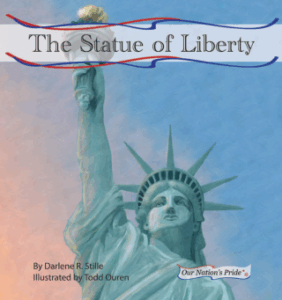 Using straightforward text and illustrations, this easy-to-read picture book introduces the history and symbolism of the famous New York City landmark, the Statue of Liberty. The text explains who designed the statue, the process behind its construction, and its significance as a symbol of freedom and a welcoming symbol to immigrants. This book is part of an ABDO series (Our Nation’s Pride) that focuses on noteworthy American symbols, inspiring children to respect and learn about national icons from an early age.
The two-page spreads feature artwork by Todd Ouren, showcasing colorful elements that complement and enhance the comprehension of Darlene R. Stille’s text, which is presented as a historical document. The illustrations serve to maintain interest without overwhelming the reader with excessive details.
This book provides a foundation for discussing the significance of American symbols and their connection to the past, while encouraging readers to recognize and understand how national symbols relate to diverse groups and cultures, as well as their evolving importance. Activities such as discussing the statue’s meaning and analyzing its symbolic elements, like the torch and crown, invite students to reflect on what the symbol means to them personally, and can deepen their understanding of the subject. Features such as “Words to Know,” “Fun Facts,” and an index support young learners’ understanding.
📚Also consider: Common Core ELA Standard. Know and use various text features (e.g., captions, bold print, subheadings, glossaries, indexes, electronic menus, icons) to locate key facts or information in a text efficiently.
- Comics Plus Collection(s): Elementary, Children’s Public Library, All-Access for Schools, Full Collection
Middle Grade
Armistice Day by Joeming Dunn and Ben Dunn (ABDO)
NCSS Theme: Time, Continuity, and Change. The learner will understand concepts such as: chronology, causality, change, conflict, complexity, multiple perspectives, primary and secondary sources, and cause and effect.
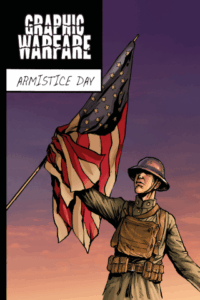 Told through a discussion between a veteran and his grandson, the story covers World War I from the beginning to its conclusion with the signing of the armistice on the “eleventh hour of the eleventh day of the eleventh month” in 1918. Readers will be introduced to significant developments in warfare at the time, like battleships, submarines, airplanes, aircraft carriers, zeppelins, and the horrors of trench warfare and poison gas. It explores the numerous treaties signed after the war to secure peace, early celebrations of the armistice, and how Armistice Day evolved into what is now known as Veterans Day in the United States.
The artwork by Ben Dunn brings key moments of WWI to life, helping readers understand the war’s complexity and its profound impact on the people of the time. Engaging images rotate between sepia tones during the pair’s conversation to nationalistic colors when presenting the historical facts.
Using Armistice Day, teachers can explore core historical concepts through the lens of chronology, causality, change, conflict, complexity, multiple perspectives, primary and secondary sources, and cause and effect. The timeline of WWI events supports lessons on chronology, enabling students to sequence battles and treaties to create their own timelines. Discussions of alliances, technology, and political tensions examine causality and cause and effect relationships, illustrating how multiple factors contributed to and shaped the war.
Visuals of battleships, poison gas, and life in the trenches illustrate change and complexity in warfare, while depictions of combat and negotiations highlight different forms of conflict. Biographical information about individual leaders provides multiple perspectives, inviting comparisons across cultures and roles. Supplementary maps, statistics, and appendices connect to primary and secondary sources, enabling students to analyze how historical materials are interpreted and understood.
📚Also consider: Common Core ELA Standard. Explain events, procedures, ideas, or concepts in a historical, scientific, or technical text, including what happened and why, based on specific information in the text.
- Comics Plus Collection(s): Elementary, Middle School, Children’s Public Library, Teen Public Library, All-Access for Schools, Full Collection
Teens
Mary Anning and the Great Fossil Discoveries by Jordi Bayarri Dolz (Lerner)
NCSS Theme: Time, Continuity, and Change: The learner will understand the origins and influences of social, cultural, political, and economic systems.
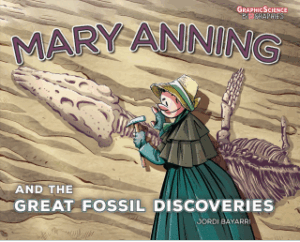 As a young child, Mary Anning accompanied her father in searching the cliffs of the Jurassic Coast in England in the early 1800s. To support her family, after her father’s death, Anning sold her findings in a local store, which soon garnered the attention of collectors and scientists from the city. Unfortunately, her contributions were often marginalized or misappropriated because of prevailing societal beliefs about class and gender.
Jordi Bayarri Dolz utilizes a cartoon-like style, with simplified backgrounds and animated depictions of Anning, her family, and friends. The color palette is reminiscent of the early 19th century, reflecting the historical setting of the story.
The lack of recognition and respect for Mary Anning’s discoveries and theories will spark a meaningful discussion about how past social, cultural, political, and economic beliefs and values have shaped attitudes toward class and gender today. The discussion will encourage readers to evaluate the impact of these beliefs on the rights of women and the poor throughout history.
Looking for more information about Mary Anning? Check out Mary Anning Breaks New Ground (Capstone).
📚Also Consider: Common Core ELA Standard. Analyze in detail how a key individual, event, or idea is introduced, illustrated, and elaborated in a text (e.g., through examples or anecdotes).
- Comics Plus Collection(s): Middle School, High School, Teen Public Library, All-Access for Schools, Full Collection
Cartoon Nation: Democracy by Liam O’Donnell and Patricia Storms (Capstone)
NCSS Theme: Time, Continuity, and Change: The learner will understand the history of Democratic ideals and principles, and how they are represented in documents, artifacts and symbols.
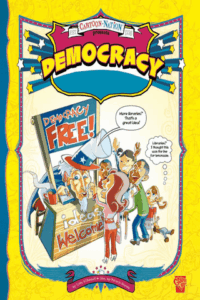 Liam O’Donnell explains the historical origins of democracy, tracing its roots back to ancient civilizations, such as Greece, where the concept of the people having a say in government first took shape. The book chronicles the global spread of democratic ideas, illustrating how various countries have adopted and adapted democracy in distinct ways. The focus gradually shifts to democracy in the United States, detailing how it functions as a system of government. Key themes include the importance of voting, citizens’ rights and responsibilities, the role of elected representatives, and the process of lawmaking and enforcement. The title serves as both an educational resource and an engaging introduction to civic participation.
Patricia Storms’ artwork makes complex concepts more accessible and visually interesting for readers, combining humor and clear visuals that help break down ideas related to democracy and government in a way that is both educational and entertaining. The cartoon images support the text by adding a playful tone, which encourages reader engagement and aids understanding of sometimes abstract political ideas.
Students and teachers can actively use Cartoon Nation: Democracy as an engaging tool to explore the history and core principles of democracy. Teachers can guide students to identify how democratic concepts such as voting, citizen participation, and government branches are essential to democracy. The title also supports learners in understanding the evolution of democratic ideals through discussions and critical thinking, encouraging them to appreciate and reflect on their role in democracy.
This book is part of a Capstone series (Cartoon Nation) that covers different concepts in American government, including the U.S. Constitution and U.S. Supreme Court, and Women’s Right to Vote.
📚Also Consider: Common Core ELA Standard. Determine a central idea of a text and analyze its development over the course of the text, including its relationship to supporting ideas; provide an objective summary of the text.
- Comics Plus Collection(s): Middle School, High School, Teen Public Library, All-Access for Schools, Full Collection
Young Adults
Lebanon Is Burning and Other Dispatches by Yazan Al-Saadi, Enas Satir, Ganzeer Ghadi, Ghosn, Hicham Rahma, Omar Khouri, Sirène Moukheiber, Tracy Chahwan (Graphic Mundi)
NCSS Theme: Time, Continuity, and Change: The learner will understand different interpretations of the influences of social, geographic, economic, and cultural factors on the history of local areas, states, nations, and the world.
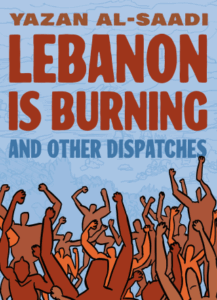 Yazan Al-Saadi collaborates with seven Middle Eastern cartoonists to present a powerful collection of fourteen nonfiction stories that document real-life protests, conflicts, and acts of resistance across the Middle East, including Lebanon, Egypt, Yemen, Palestine, Sudan, and Bahrain. Each chapter focuses on a specific historical moment, such as the 2019 Lebanese uprisings (“Lebanon Is Burning”); the 2011 protests in Bahrain (“Bahrain’s Inconvenient Revolution”), and life in Egypt under the Sisi regime (“Eppur Si Muove” and “Cairo Under the Crackdown”).
One of the most moving pieces, “Unstoppable Force,” recounts the double blow of the COVID-19 pandemic and the devastating August 4, 2020 explosion in Beirut. While the events described are factual, they are presented from Al-Saadi’s perspective, meaning readers may disagree with his interpretations.
The book’s impact is heightened by the artwork from seven different artists from across the Middle East and North Africa, each one bringing a distinct style, ranging from realistic to cartoonish illustrations. This variety reflects the diversity of ways in which people experience events. The visual shifts between chapters not only keep the reading experience fresh and engaging, but also deepen the narrative, making the stories more vivid and meaningful.
Lebanon Is Burning and Other Dispatches offers a valuable opportunity to explore the social studies concept that history is complex, multifaceted, and influenced by geography, culture, politics, and economics. By engaging with these firsthand narratives and diverse artistic interpretations, students can see how local perspectives intersect with global issues. Teachers can use these stories to foster discussions about bias, perspective, and the construction of narratives, helping students to distinguish between events and the interpretations built around them.
Most importantly, it encourages learners to see that disagreeing with an author’s perspective does not diminish the truth of the events described; it instead opens the door to a richer, more critical engagement with history.
📚Also Consider: Common Core ELA Standard. Analyze a complex set of ideas or sequence of events and explain how specific individuals, ideas, or events interact and develop over the course of the text.
- Comics Plus Collection(s): High School, Teen Public Library, All-Access for Schools, Full Collection
Alexander Hamilton by Rod Espinosa (Antarctic Press)
NCSS Theme: Time, Continuity, and Change. The learner will understand the contributions of philosophies, ideologies, individuals, institutions, and key events and turning points in shaping history.
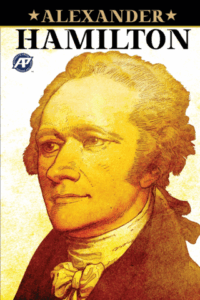 This engaging graphic novel brings Alexander Hamilton’s remarkable story to life, from his modest beginnings in the Caribbean to his influential role as one of America’s founding fathers. Readers follow Hamilton as he works alongside George Washington, shaping the new government and championing critical institutions such as the central bank. The exploration of Hamilton’s personal struggles, his rivalry with Thomas Jefferson, and the dramatic circumstances of his death in a duel with Aaron Burr significantly contribute to the shaping of U.S. history.
Rod Espinosa’s illustrations are both accessible and richly detailed, featuring crisp lines, expressive faces, and clean, easy-to-follow layouts. He uses clear backgrounds and thoughtful visual cues to highlight major historical events and figures. Soft, balanced colors and shading keep the pages visually inviting without being overwhelming, making complex historical events more accessible for all readers.
Teachers can use Espinosa’s Alexander Hamilton to spark discussion about the connections between people, ideas, and pivotal events in early American history. By leveraging the engaging storytelling and visuals, teachers can bring to life the interconnectedness of individuals, institutions, and major events, helping students see how these elements have shaped the nation’s development.
Hamilton’s journey is an ideal case study for lessons focused on how personal background influences leadership and vision. Classroom exploration of his debates with Jefferson will showcase the diversity of thought that shaped the nation. Key institutions such as the central bank come alive within the narrative, making abstract concepts concrete for students. The book’s timeline, spanning the Revolutionary War to his duel with Burr, includes textual evidence that offers vivid highlights to examine turning points in American history, enriching readers’ understanding of the era’s intense personal and political stakes.
📚Also Consider: Common Core ELA Standard. Cite strong and thorough textual evidence to support analysis of what the text says explicitly as well as inferences drawn from the text.
- Comics Plus Collection(s): High School, Teen Public Library, All-Access for Schools, Full Collection
Vickie Blankenship and Stella Bromley are Engagement Specialists for LibraryPass, as well as school librarians and educators with extensive experience in librarianship at the elementary, middle, and high school levels. Both bring expertise in professional development and educator training, working with school districts nationwide. They have presented locally, regionally, and nationally on best practices for collection development, library programming, and classroom pedagogy. Active members of their state library associations, they are dedicated to fostering a love of reading in students and educators alike. They share a passion for connecting readers with the “just-right” book and believe that reading takes many forms, whether it’s traditional print books, comics, graphic novels, or manga; as long as readers are engaged with a book, their love for reading will grow.
Read All The Comics!

“An absolute game changer.” School Library Journal
With Comics Plus, schools and libraries can offer readers unlimited access to thousands of digital comics, manga, and picture books from popular publishers like ABDO, Andrews McMeel, Capstone, Cherry Lake, Dark Horse, Europe Comics, Fantagraphics, Humanoids, IDW, Image Comics, Kodansha, Lerner, Mad Cave, Manga Classics, Oni Press, Papercutz, Tokyopop, TOON Books, UDON Entertainment, Yen Press, and dozens more.
No holds, wait lists, or monthly borrowing limits—all at a price that won’t break your materials budget.
Learn more at comicsplusapp.com and sign up for a free demo account.
 We curate high-interest, immersive digital content that helps schools and libraries expand and diversify their collections—without breaking their materials budgets.