
Danielle Schafer, Head Librarian at Salem Church Middle School (Virginia) presented on “Visual Storytelling: Embracing Graphic Novels School-Wide” for our “Comics & Manga Programming in Schools and Libraries” webinar at LibraryCon 2024. We’re spotlighting our key takeaways here for those who prefer reading over video or audio, but the full webinar is also embedded below.
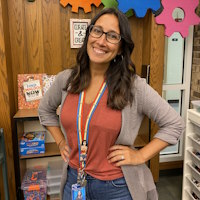 Danielle Schafer, the Head Librarian at Salem Church Middle Schools in the Chesterfield County Schools District in Virginia, knew that graphic novels could support visual literacy and foster creativity for her students. Receiving buy-in from teachers and administrators to approve a school-wide reading program was a hurdle, but Danielle strongly believed graphic novels could be a great engagement tool, so she proposed her programming idea with facts and figures to support her belief, and to deliver measurable results.
Stage 1: Setting Goals
Before Danielle began with her school’s first school-wide read using a graphic novel, she thought about the goals she hoped to achieve with the program. Establishing school-wide read goals can seem like a challenge, especially by grade level. As a school librarian, Danielle knew her audience of decision-makers (the principal and teachers) and the needs of their audience, students, too!
Danielle defined eight goals that would serve to help inform teachers and administrators about why graphic novels were worth implementing through a school-wide reading program. Among those eight goals were fostering community, supporting curriculum goals, and inspiring creativity. For everyone to embrace a school-wide read, she knew how important it would be to create a program that was equitable and accessible as well.

Danielle Schafer’s school-wide read goals were aligned with Salem Church Middle School’s administration and teaching staff’s expectations.
Stage 2: Decisioning + Buy-in
Comics Plus provides unlimited, simultaneous access to thousands of graphic novels, manga, and picture books, making every title available to every student at any time. Combining this fact with their library’s quarterly circulation data, Danielle was able to drive buy-in from her principal and teachers — each group being a hard sell on the value of graphic novels and manga in schools.
Forty to forty-five percent of the library’s physical checkouts were graphic novels and manga, despite the school’s collection consisting of a relatively small number of graphic novels when compared to the other types of books available to Salem Church’s students.
“Graphic novels really support visual literacy, foster creativity, and our number one thing, engaging our readers… There is amazing data [about visual literacy],” Danielle says. This was validated by articles she found from School Library Journal and the Northwestern Center for Talent and Development.
Stage 3: Implementation
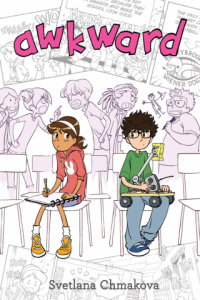 A big component to the success of a school-wide reading program is the chosen title. Danielle made sure to select something that would connect with her students: Awkward. It’s about middle schoolers navigating a new level of preteen-hood, as Penelope has to deal with surviving her first day at a new school and figuring out which club to join.
In addition to reading the book together, the learning curriculum tasked students to write about what clubs they would like to see at their own school: “If you could start club at Salem, what would it be?”
Awkward was read during enrichment periods for 20-30 minutes each morning at Salem Church Middle School during the school-wide read. Danielle made this possible by putting together a detailed plan for teaching staff and administration, including building prior knowledge for the material; creating a reading calendar; adding recorded readings and discussion questions; and making the content connections clear for everyone.
“Text and images combined foster greater critical thinking of elements of storytelling; from foreshadowing to character development, along with making inferences,” Danielle explains.
Stage 4: Measuring Impact
After the first few weeks of the school-wide reading of Awkward, Danielle measured the program’s effectiveness based on the original 8 goals she used to drive buy-in. She was able to tie the impact of the school-wide read to Claim, Evidence, and Reasoning (CER), a writing tool her teachers were keen to see applied with the program. Interestingly, English and Social Studies teachers were able to expand from these persuasive essay tasks into other curriculum for their subject areas, too.
The program also helped foster community among students who found shared interests with others, connecting Penelope’s experience in Awkward to their own assignment to identify a club they wanted to create at Salem Church Middle School . The overall positive reading experience happened through text connections and real-world application and impact.

Danielle Schafer’s results at Salem Church Middle School after using the graphic novel, Awkward, in a school-wide read initiative.
Stage 5: Results
Celebrating her wins with this program was easy for Danielle to do after seeing, and showing, how well it worked.
The school-wide read of Awkward led to 920+ essays from students, 40 applications for school clubs, and the creation of 16 of those clubs. Two hundred and thirty-five students joined those newly created clubs in 2023, and over four hundred and fifty participated the next year!
“We took our whole-school read and was able to show, not only my principal, but our teachers, that [graphic novels] are valuable; that they can connect to [teachers’] content, and that they can have a greater impact if we choose to help bridge them.” Danielle states.
What can you achieve with your readers by bringing comics and manga into your school-wide programming?
** Learn more about Comics Plus and our valuable resources, including the Comic & Manga Book Club Guide. **
Comics & Manga Programming in Schools and Libraries | LibraryCon 2024
Librarians Tabrizia Jones (NYPL), George Purdu (Wyandotte Public Schools), and Danielle Schafer (Chesterfield County Schools) share insights about managing and promoting their comics and manga collections.
View the full archived recording here, and then check out additional resources and download a certificate of completion.
Read All The Comics!

“An absolute game changer.” School Library Journal
With Comics Plus, schools and libraries can offer readers unlimited access to thousands of digital comics, manga, and picture books from popular publishers like ABDO, Andrews McMeel, Capstone, Cherry Lake, Dark Horse, Europe Comics, Fantagraphics, Humanoids, Image Comics, Kodansha, Lerner, Mad Cave, Manga Classics, Oni Press, Papercutz, Tokyopop, TOON Books, UDON Entertainment, Yen Press, and dozens more.
No holds, wait lists, or monthly borrowing limits—all at a price that won’t break your materials budget.
Learn more at comicsplusapp.com and sign up for a free demo account.
 We curate high-interest, immersive digital content that helps schools and libraries expand and diversify their collections—without breaking their materials budgets.